


David Darcy

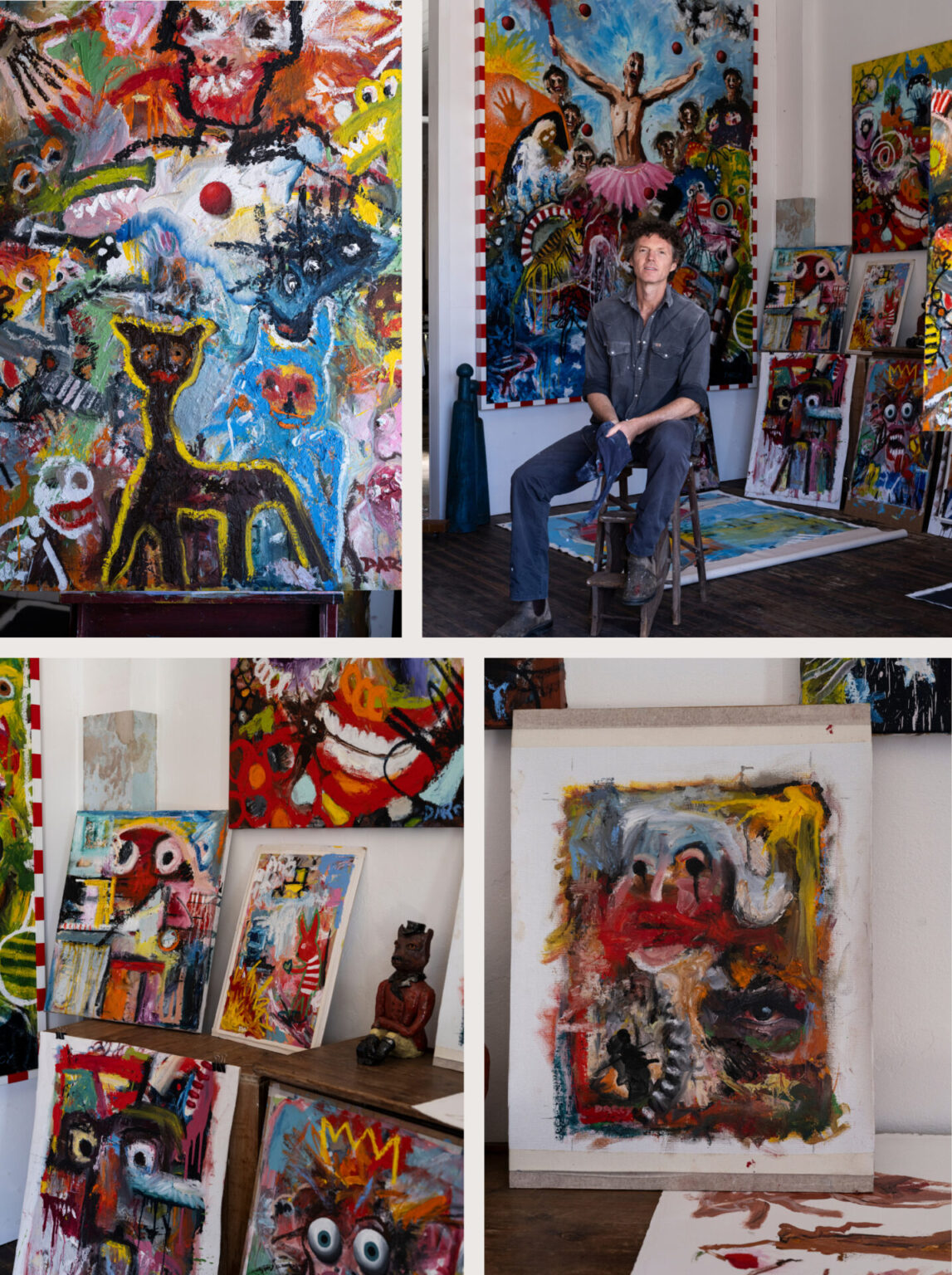
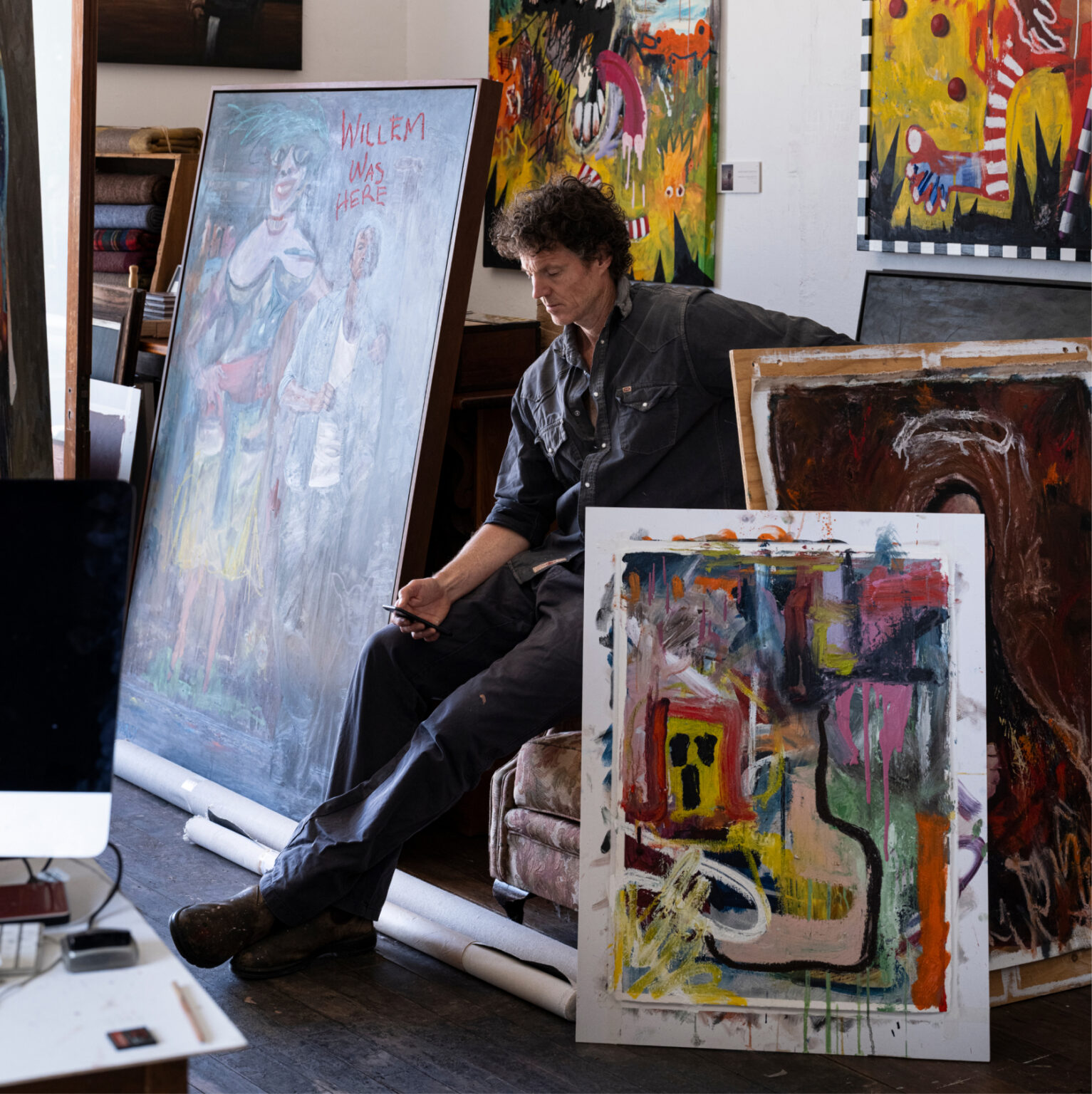
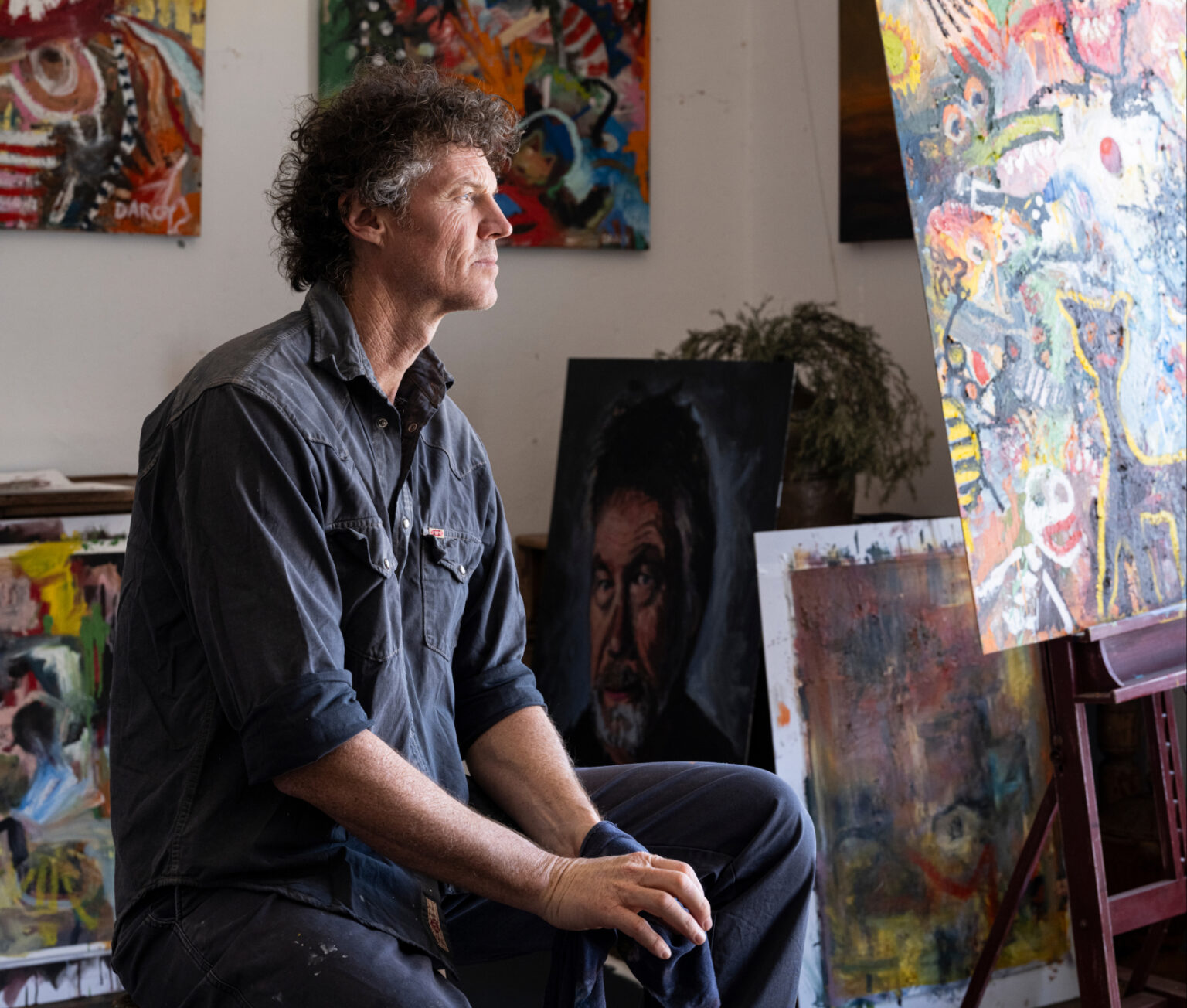
For this month’s edition of The Murrurundi Argus, we visit the hive of creative activity that is the painting studio of Murrurundi local and many-time Archibald Prize finalist David Darcy. In our wide-ranging conversation, we discuss the artist’s practice to date and the bold departure represented by his new series, Self Sabotage – set to debut in his solo exhibition at Tamworth Regional Gallery, co-presented with Michael Reid Murrurundi.
Born in the Blue Mountains of New South Wales and now based in Murrurundi, David Darcy has amassed numerous accolades across his celebrated career, including the People’s Choice Award in the 2019 Archibald Prize for his portrait of Daisy Tjuparntarri Ward, as well as The Darling Portrait Prize and The National Photographic Portrait Prize. This month, he received his latest Archibald Prize nod for his portrait of fellow artist Dale Frank, which is on view at the Art Gallery of New South Wales from 9 May to 16 August.
“A portrait can delight, disturb, reconcile or reject,” says Darcy in the 2024 hardcover About Face by writer and curator Amber Creswell Bell, who devotes an extensive chapter to the artist’s work in the book’s survey of the greatest portraitists working in Australia and New Zealand today. “It can reflect reality back to the world with photorealism just as well as it can fantasise, distort, invent and upend.”
Darcy, who enjoyed a successful career in photography for 15 years before turning his hand to painting in 2016, has never recoiled from a radical pivot, and his latest project – the winkingly titled solo exhibition Self Sabotage, on view at Tamworth Regional Gallery in a co-presentation with Michael Reid Murrurundi – represents a bold departure from the painterly mode with which fans of his celebrated Archibald works will be most familiar.
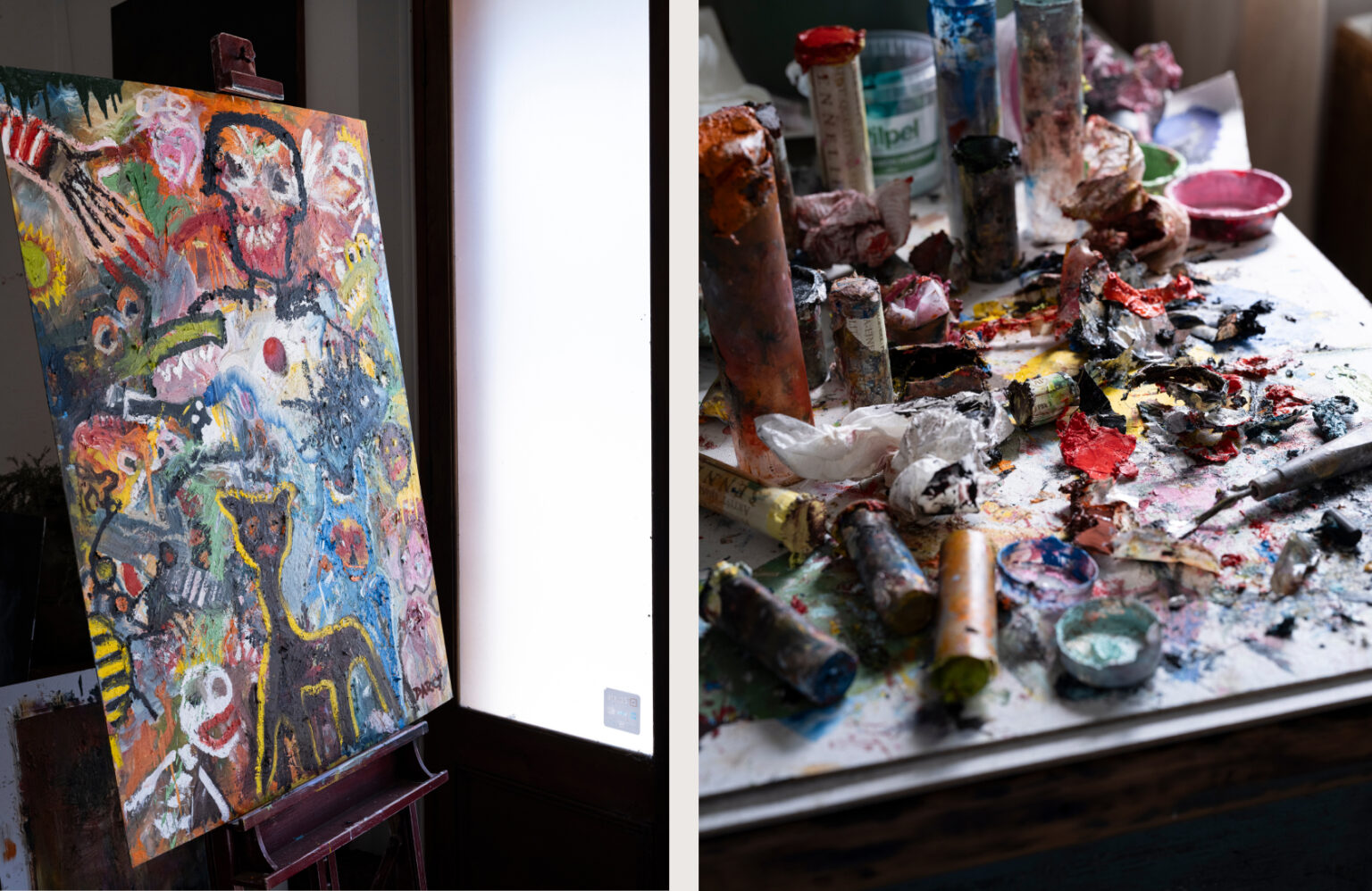
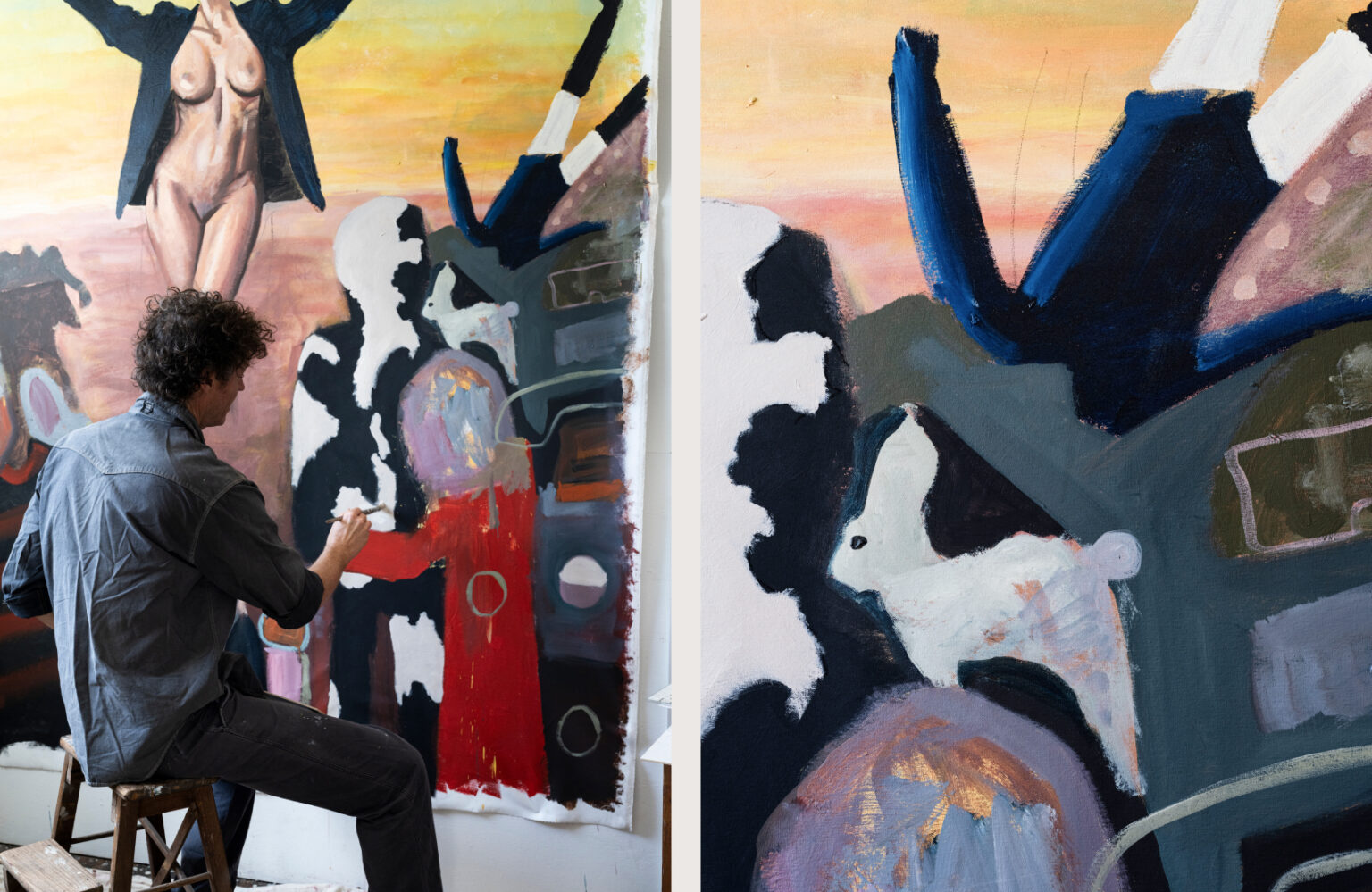
Breaking from coolly precise photorealism into a bold, hot-blooded, De Kooning–indebted expressionism, Self Sabotage is playfully likened to an act of iconoclasm, taking a hammer to Darcy’s own established art-world image in pursuit of an honest, open-ended creativity. “Of course many people will see this as a new direction, but I view it more as new influences in my life,” says the artist in our interview, available to explore below. “Of course I still love traditional portraiture, and I look forward to practising both. You can choose to build a tall skyscraper or lots of little houses everywhere.”
“Having achieved great recognition for traditional portraiture, Darcy once again reinvents his practice with this body of work,” note the Tamworth curators. “From traditional to abstraction, the portrait becomes alchemy, where faces bloom from landscapes, fracture into myths and borrow masks from memory. Identity is not captured but negotiated, revised with every brushstroke. Self Sabotage hosts a metamorphosis, staging the fragile theatre of who we might be.”
Works from Self Sabotage are available to acquire from Michael Reid Murrurundi. The exhibition is on view at Tamworth Regional Gallery from 8 May to 21 June. To request a catalogue and discuss available works, please email amandamackinlay@michaelreid.com.au
Could you tell us about some of your early creative influences?
As a young boy, around 10 years of age, I became fascinated by the art world. I would find myself escaping the domestic violence of the family home to sit in the local library and pore through books by Tucker, Drysdale, Boyd and Nolan. I remember borrowing the same books again and again and noticed my name was the only name that appeared on the library card envelope pasted on the inside jacket of the book. I was a real dreamer as a child and the Angry Penguins movement sounded like the coolest gang ever.
What led you to pursue painting as a career, and what informed your work during that earlier period? How have those influences, ideas or approaches woven through your work since then?
Even though I achieved great acknowledgement as a young boy for drawing and photography, I never really had the guidance, maturity or confidence to take it on as a career when I left school and I really regret that! Instead I travelled and worked an array of professions to feed myself. Then, when I was 27, I picked up a camera in an effort to connect with a vacant father, who was also a photographer. I spent 16 years as a professional photographer, writing books, working on movies, shooting campaigns for advertising, animal welfare organisations or publications. It was a wonderful career but it wasn’t that young boy’s dreams, and impressing my father lost its meaning. So in 2016 at age 43 I picked up a paintbrush for the first time since high school and I started painting. The last ten years are the most content I’ve ever felt.
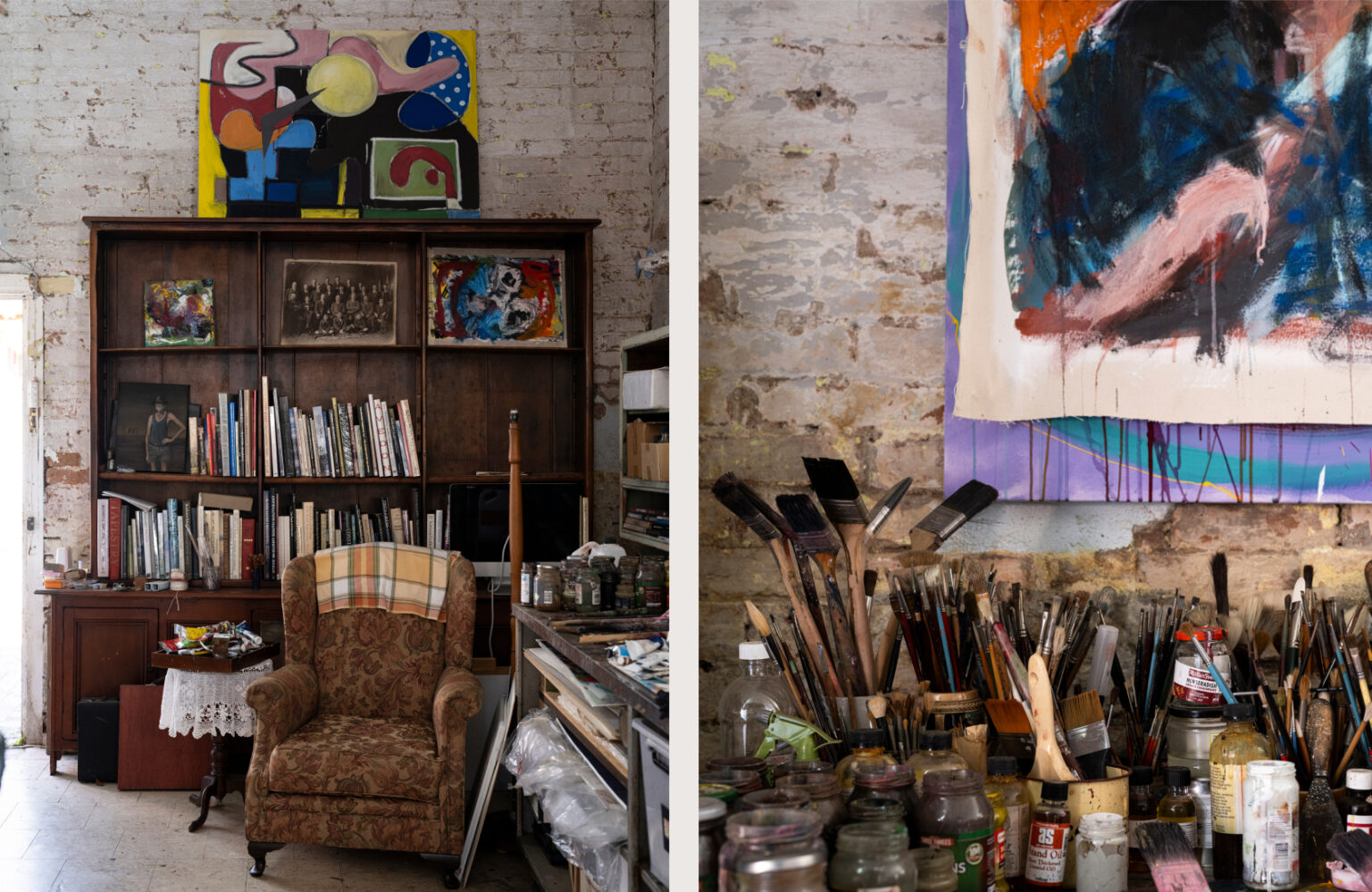
How did you develop your approach to painting over time? Are there references, themes, styles, ideas or techniques that you have continually returned to in your work?
Having started painting later in life I felt an urgency to develop as quickly as possible. After achieving success in the photography industry, I lent heavily on the skills I had learnt in the darkroom, lighting, composition, colour balance, values/exposure. I knew I had an advantage with my reference material, so then it was just night after night watching YouTube videos on how to mix paint, what to mix, layering, blending, mediums, paint brands, etc, etc. My photography heavily influenced my portrait painting, and still does. But over time I’ve become less reliant on it, and more confident with the brush.
What have been some of your favourite career experiences or moments of creative breakthrough in your practice?
Achieving recognition for your work is incredibly validating. Winning the People’s Choice Award at the Archibald Prize in 2019, three years after picking up a brush, is a moment that is hard to top. But last year I was commissioned by Parliament House for the Historic Memorials Collection. Only a handful of artists are ever chosen for this and this is a great honour. Knowing my name and my painting will hang in perpetuity in Parliament House is a career highlight. But I’m also confident that there is something greater to come or I’m just delusional.
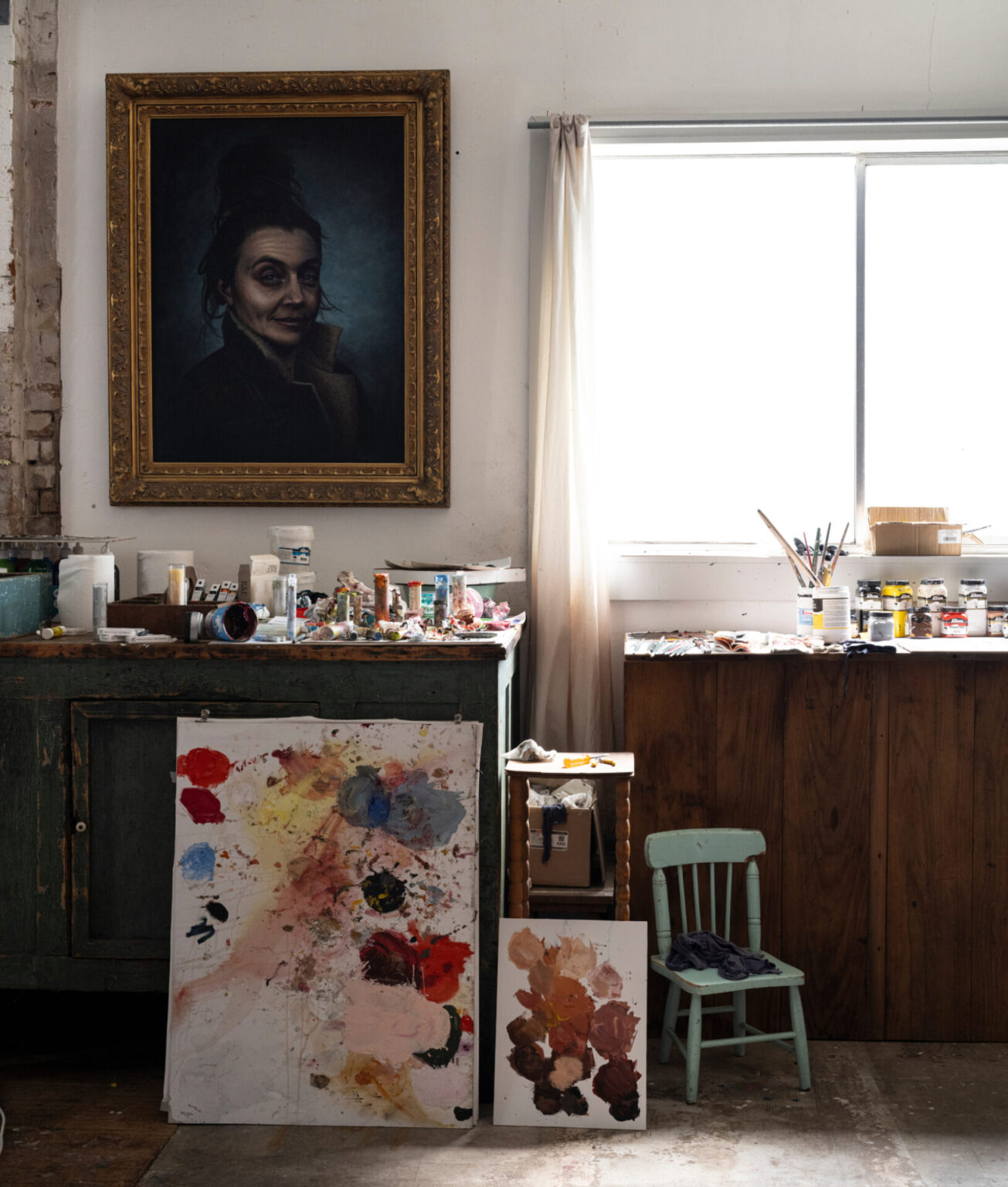
What was the starting point for your Self Sabotage series? Could you tell us about some of the ideas, influences and approaches that you wanted to explore with this body of work?
In 2023 I had a pivotal moment in life. I was re-introduced to expressionism by my friend Jelha Van Den Berg. He helped me understand its value. I stood in front of a De Kooning and I got it. It felt as though a veil had been lifted. For the better part of my life I had ignorantly ignored abstraction and expressionism. Then it just came flooding in. Self Sabotage is an opportunity to question everything. “You can lead a horse to water, but you can’t make him drink” rings very true for this exhibition. I don’t expect to change people’s minds, I can only be true to myself. I know many people won’t understand why I would sabotage my own practice, but I need to. I’m not seeking validation or approval, I’m pushing my own boundaries and preconceptions. Self Sabotage is my chance to let go, to feel the breeze in my hair, scream at the sky and throw paint at the wall. Like Luke Skywalker on his last run at the Death Star. I can’t explain why, I just have to trust my gut.
What were some of the challenges or questions that you were working through in the creation of your Self Sabotage series?
This exhibition has made me question everything. It’s very easy to believe you’re on the right path. But paths are always intersecting and crossing. I think it’s healthy to question yourself and your actions regularly. I’m not a fan of being boxed in.
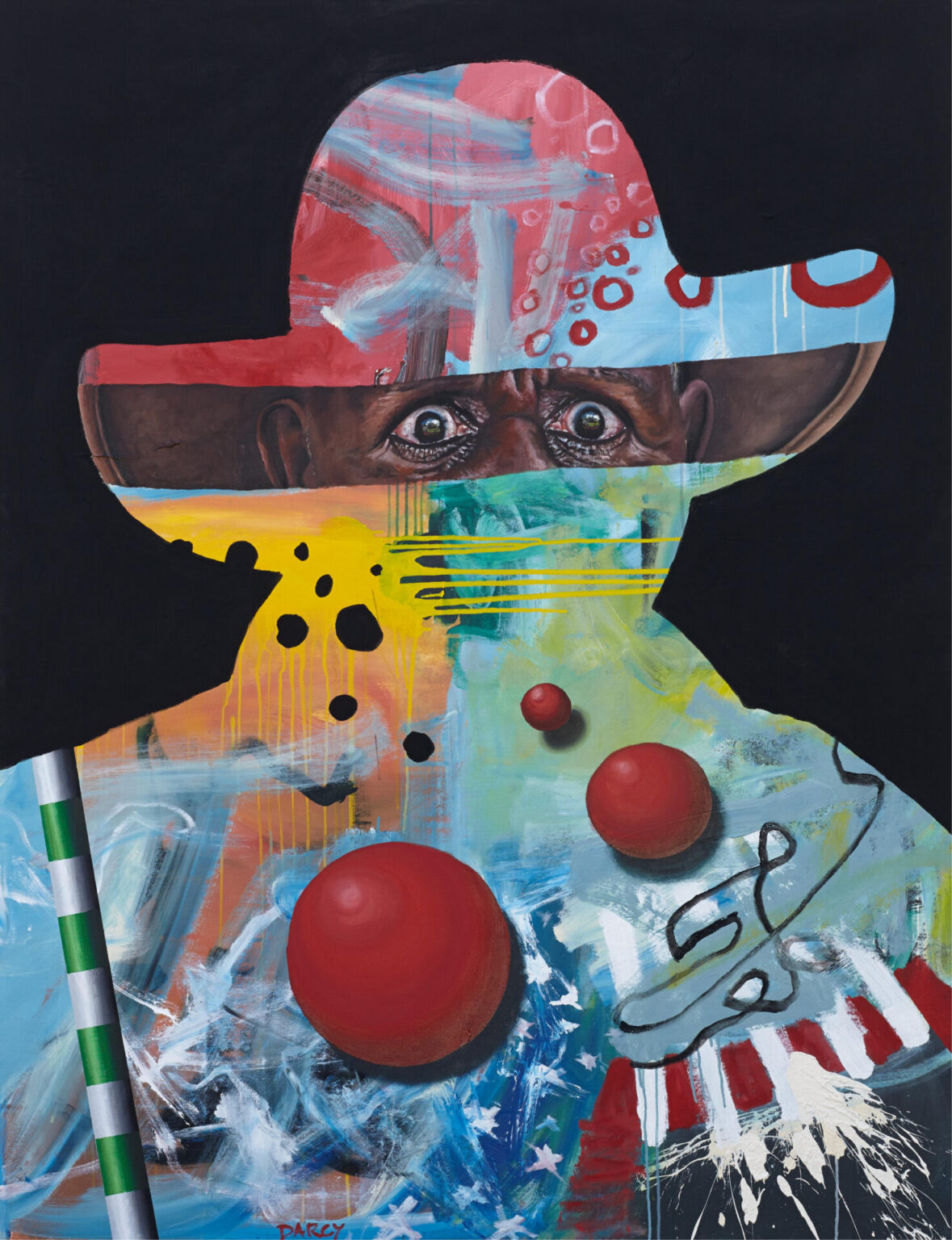
How does this series build on your previous work or perhaps offer a new direction in your practice?
Of course many people will see this as a new direction, but I view it more as new influences in my life. Of course I still love traditional portraiture, and I look forward to practising both. You can choose to build a tall skyscraper or lots of little houses everywhere.
Could you tell us about your favourite works from the series?
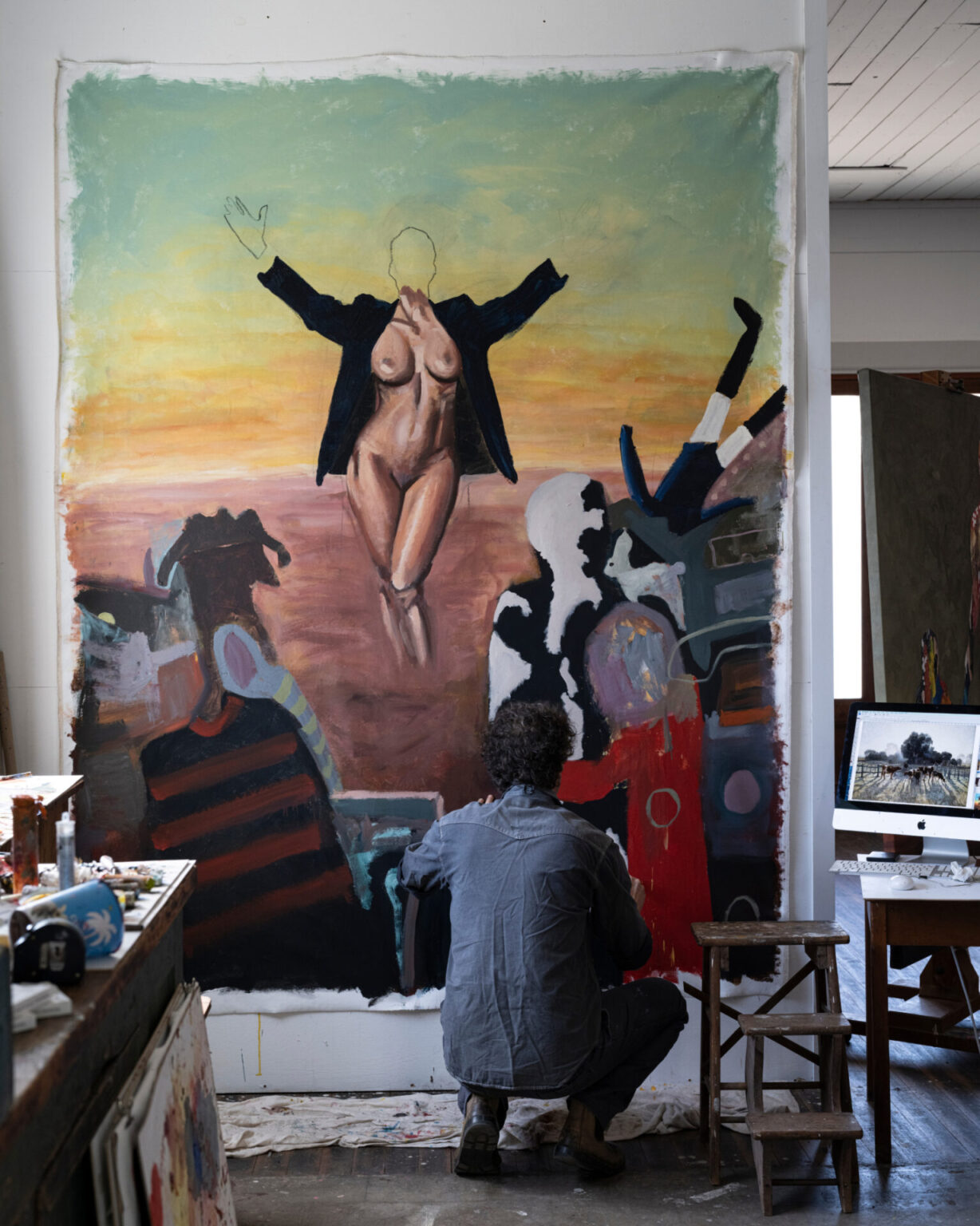
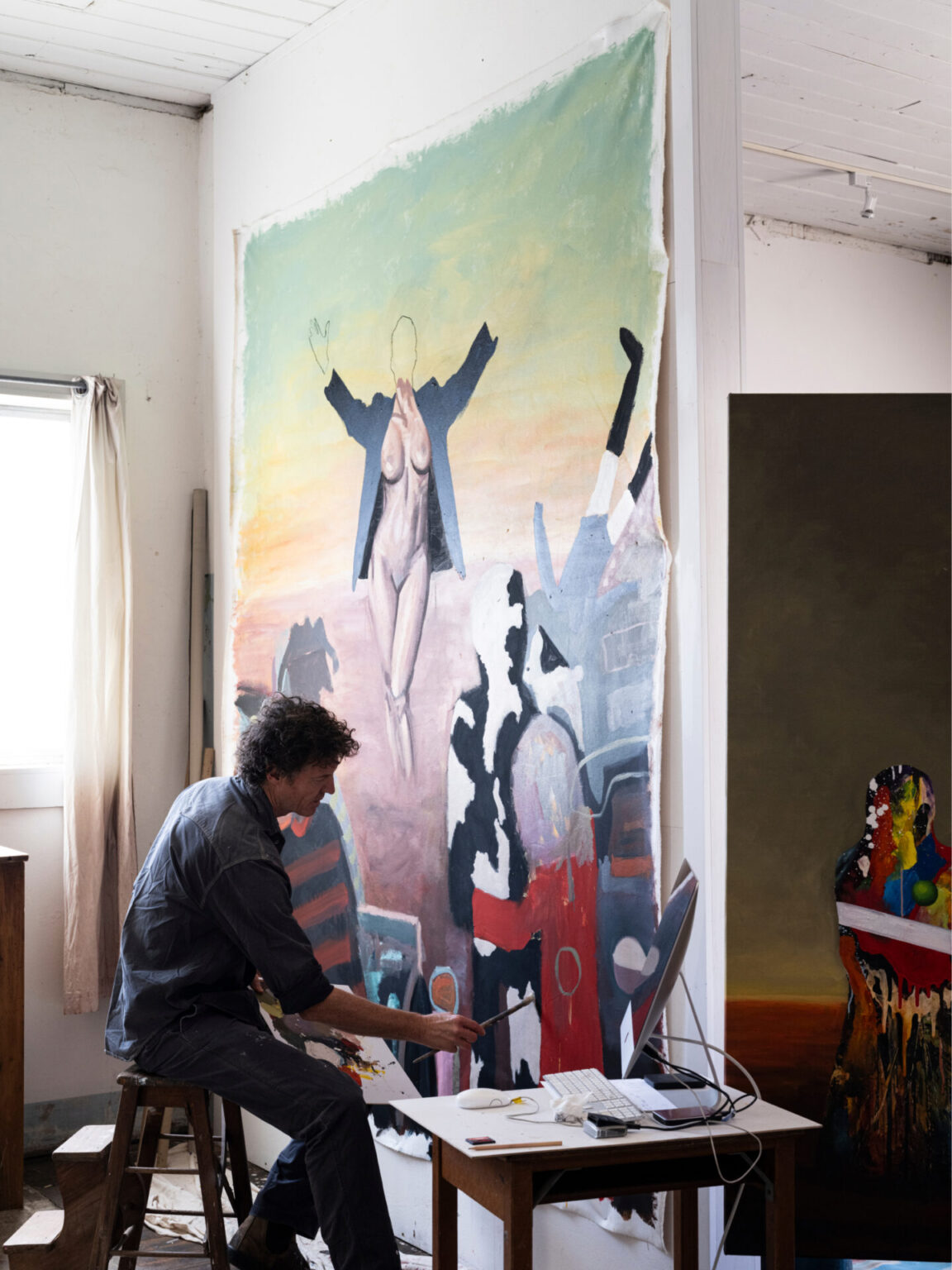
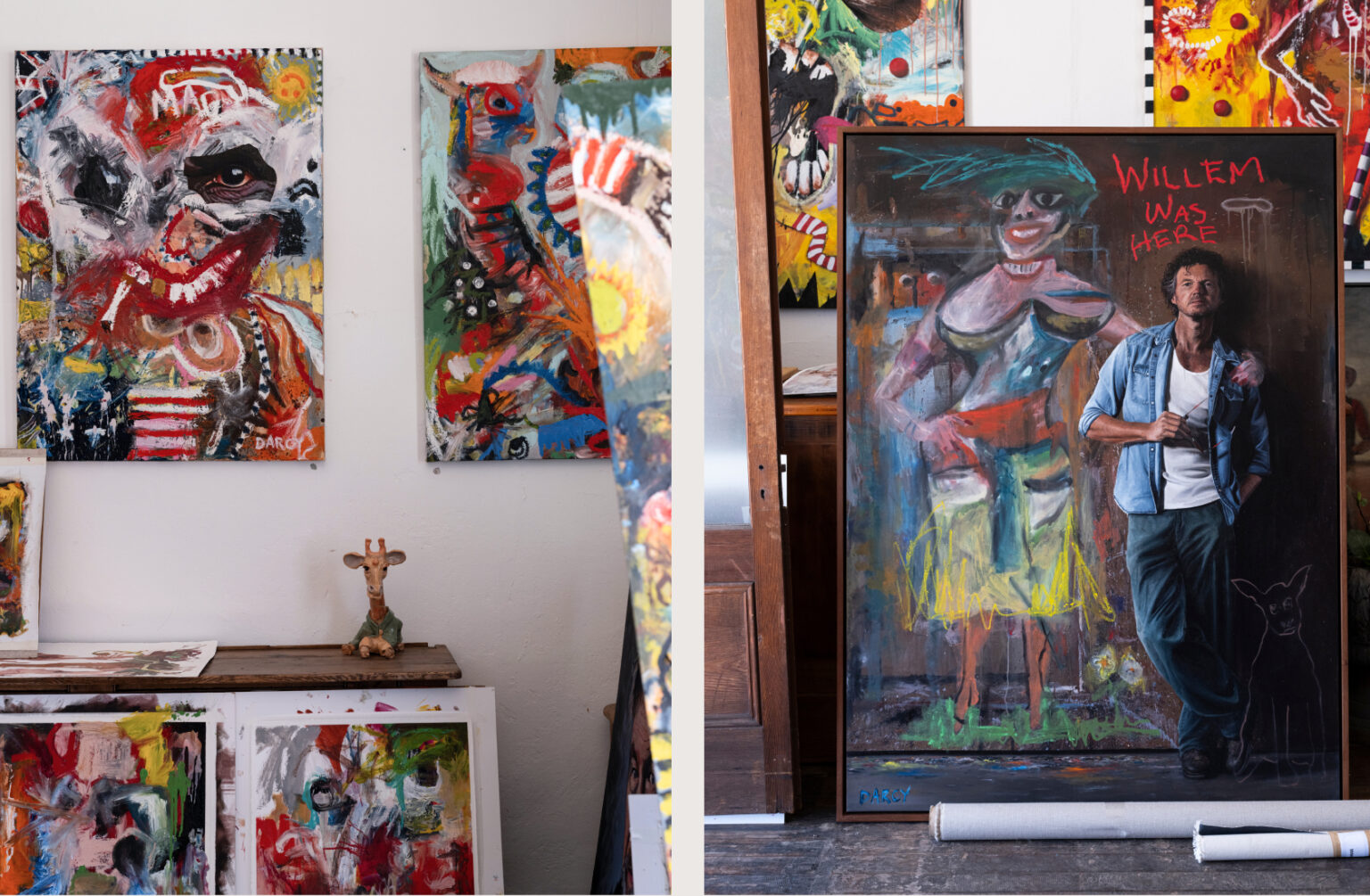
There are two paintings that best sum up this exhibition for me. The first one is Self-portrait in studio – Homage to De Kooning. This painting allowed me to bridge the two genres, to express my gratitude to a great artist as well as acknowledge my own journey to date. The second painting is Oi Oi Oi. This large-scale work was my freedom piece. Whilst I was painting the commissioned portrait of Bob Katter for Parliament, I found myself wandering over to this painting in the afternoons and just relaxing into a different mindset. I didn’t construct this painting; it just happened before me over time. It’s my most honest portrait to date.
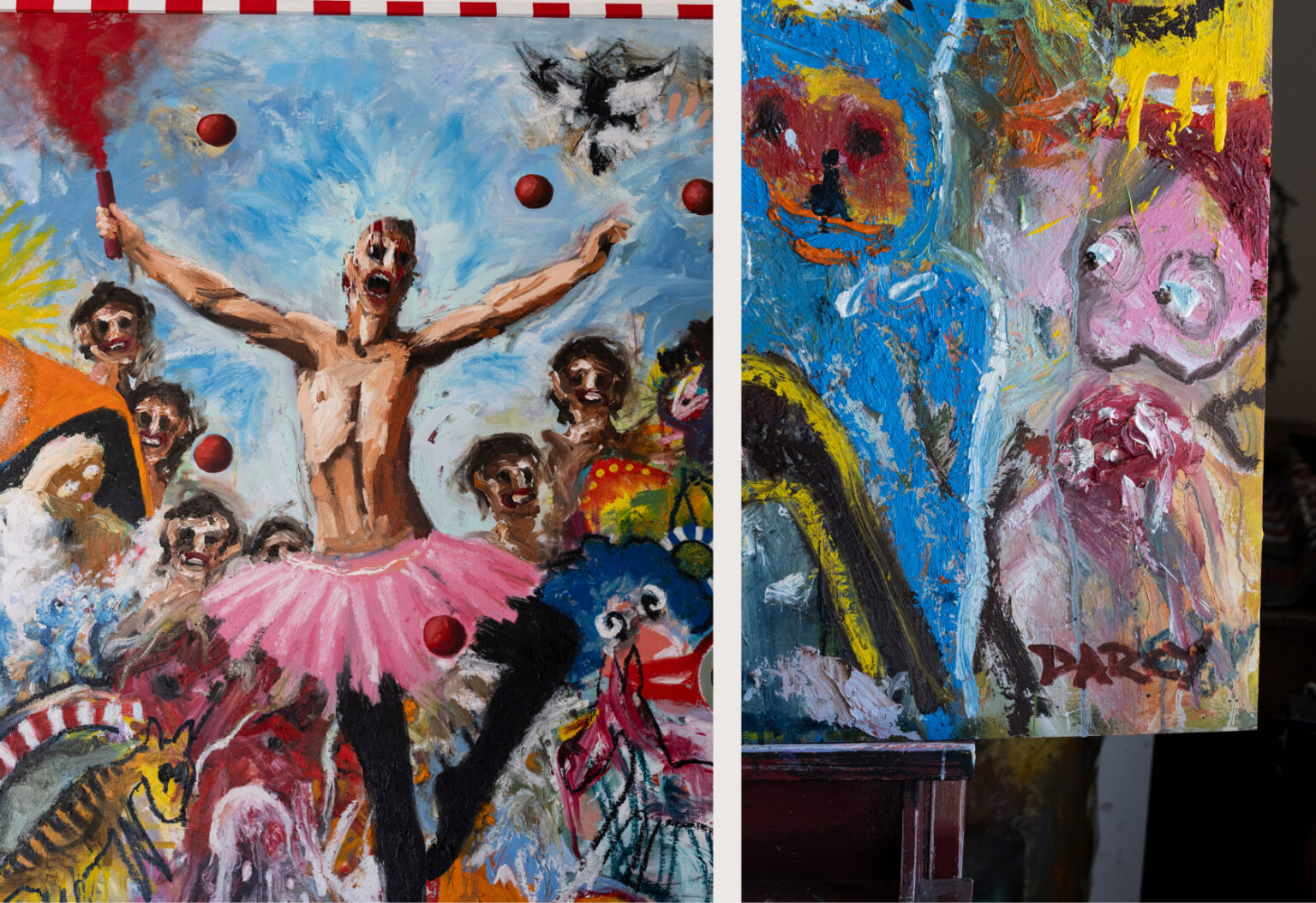
How do you hope visitors will experience your Self Sabotage paintings at Tamworth Regional Gallery?
I really don’t know how visitors will experience this exhibition. I would like to think that they will know a little more about me. Traditional portraits don’t give the artist a lot of opportunity to tell the audience who they are. Self Sabotage is me, in all my mixed-up glory, with nothing to hide.
What other projects are you looking forward to working on in the coming year – perhaps building on the direction opened up by Self Sabotage?
I’m not sure what is next. I have a thousand new ideas every day. I think I’m just going to enjoy the next few weeks as I reflect on the work I’ve just created. Then, when the studio calls me to create, I’ll create. I hope one day I’ll look back on this work with great fondness, because it feels like a moment of freedom. I’m free to explore, and that’s a bloody good feeling.


- XXXVIII LA Story by Michael Reid OAM April 2024
- LIV A Network is a Portfolio: Mid-Year Notes on the Art Market July 2026
- LIII Building an AI-Ready Gallery: Part 1 July 2026
- LII David Darcy May 2026
- LI Shinola March 2026
- L The Art of Jim Naughten & A Brave New World March 2026
- XLIX Paddy’s Cottage November 2025
- XLVIII Washington DC by Michael Reid OAM November 2025
- XLVII The Outdoor Fireplace at Murrurundi by Michael Reid OAM October 2025
- XLVI Amelia Zander of Zander & Co. July 2025
- XLV Marlie Draught Horse Stud by Michael Sharp June 2025
- XLIV Trump Engulfed the Fires by Michael Reid OAM February 2025
- XLIII Newcastle by Jason Mowen October 2024
- XLII The Business of Gardening by Michael Reid OAM September 2024
- XLI Carly Le Cerf by Sarah Hetherington August 2024
- XL Pecora Dairy by Michael Sharp July 2024
- XXXIX Joseph McGlennon by Michael Reid OAM May 2024
- XXXVII Julz Beresford by Michael Sharp March 2024
- XXXVI Sydney Contemporary by Jason Mowen February 2024
- XXXV The US of A by Michael Reid OAM December 2023
- XXXIV Scone Grammar School’s principal Paul Smart by Victoria Carey November 2023
- XXXIII AgQuip by Jason Mowen October 2023
- XXXII Tinagroo Stock Horse’s Jill Macintyre by Victoria Carey September 2023
- XXXI The Old Gundy School House by Victoria Carey August 2023
- XXX Annette English by Victoria Carey July 2023
- XXIX The Ghan by Jason Mowen June 2023
- XXVIII All in the family: The Arnotts May 2023
- XXVII A Capital Plan by Jason Mowen March 2023
- XXVI Mandy Archibald March 2023
- XXV Paul West February 2023
- XXIV The Other Newcastle by Jason Mowen January 2023
- XXIII Mount Woolooma Glasshouse at Belltrees December 2022
- XXII Murrurundi to Matino: with Jason Mowen November 2022
- XXI James Stokes October 2022
- XX Adelaide Bragg September 2022
- XIX Tamara Dean August 2022
- XVIII Going home: Angus Street July 2022
- XVII Belltrees Public School June 2022
- XVI A Road Trip on the New England Highway May 2022
- XV David and Jennifer Bettington: from horses to houses April 2022
- XIV Denise Faulkner: Art of the Garden March 2022
- XIII Childhood memories: Willa Arantz February 2022
- XII Riding ahead: Giddiup January 2022
- XI Ingrid Weir’s rural life December 2021
- X Life by design: William Zuccon November 2021
- IX Life on the land: The Whites October 2021
- VIII Goonoo Goonoo Station September 2021
- VII Murrurundi: a garden playground August 2021
- VI Pat’s Kitchen July 2021
- V A creative life: Charlotte Drake-Brockman June 2021
- IV Magpie Gin May 2021
- III The Cottage, Scone April 2021
- II At home with Jason Mowen March 2021
- I A town that performs February 2021
