


The Art of Jim Naughten & A Brave New World

In the lead-up to Jim Naughten’s first exhibition at our flagship Eora/Sydney gallery, Michael Reid OAM offers his reflections on the British artist’s innovative practice – one that bridges classical image-making with ascendant technologies and points the way towards art’s brave new world.
Having tried, with some deliberate prejudice, to consign them to the dustbin of my ageing memory, who could truly forget the fiasco that was the spruiking of Non-Fungible Tokens (NFTs)? They were, indeed, token.
NFTs served as a refuge for the beguiled and the charlatan – a space where people became so enamoured with the mechanism of the technology that they paid almost no heed to the actual outcome of the work. The marketing push was dominated by the how: an endless, dizzying techno-loop of hype centred on digital wallets and the supposed intricacies of the blockchain. Yet in this environment, the medium did not merely carry the pitch – it obliterated the outcome. One would hear endlessly about the supposed wizardry of the process, only to be presented, at the end of it all, with a piece of “art” (to use the term loosely): a dolphin, perhaps, or a dolphin playing cards around a table with other dolphins.
This pattern is hardly new. The art world has encountered it repeatedly whenever a new medium emerges. In the nineteenth century, early photography provoked long debates about whether the mechanical capture of an image could ever rise to the level of art, with critics and practitioners often more fascinated by the chemistry and apparatus than by the pictures themselves. A century later, the arrival of video art in the 1970s produced a similar moment: artists and audiences alike were dazzled by the novelty of portable cameras and monitors, sometimes mistaking technical novelty for aesthetic achievement. The digital art boom of the 1990s repeated the cycle once more, with endless discussion of software, pixels and processing power, while the visual outcomes frequently struggled to justify the technological excitement surrounding them.
The hype surrounding NFTs simply repeated this familiar pattern. When new technologies enter the art world, they are often embraced first by those fixated on the mechanism itself. In their obsession with the how, they never truly grapple with the what – the aesthetic or emotional value of the result. The techno-disciples become so entranced by the tools that the final outcome becomes an afterthought, proving once again that a high-tech delivery system can never disguise a complete absence of substance.
The use of Artificial Intelligence in art, however, is an entirely different matter. Almost no artists – and certainly very few artists of real standing – were intricately involved with the construction of NFTs. The techno wizards literally became the NFT artwork. In the brave new world of AI, however, artists are using it as they would a paintbrush or a Hasselblad camera, augmenting their own extraordinary creative abilities with a new visual tool. Great artists can use AI, whereas with NFTs, only the techno wizards could truly operate the machinery.
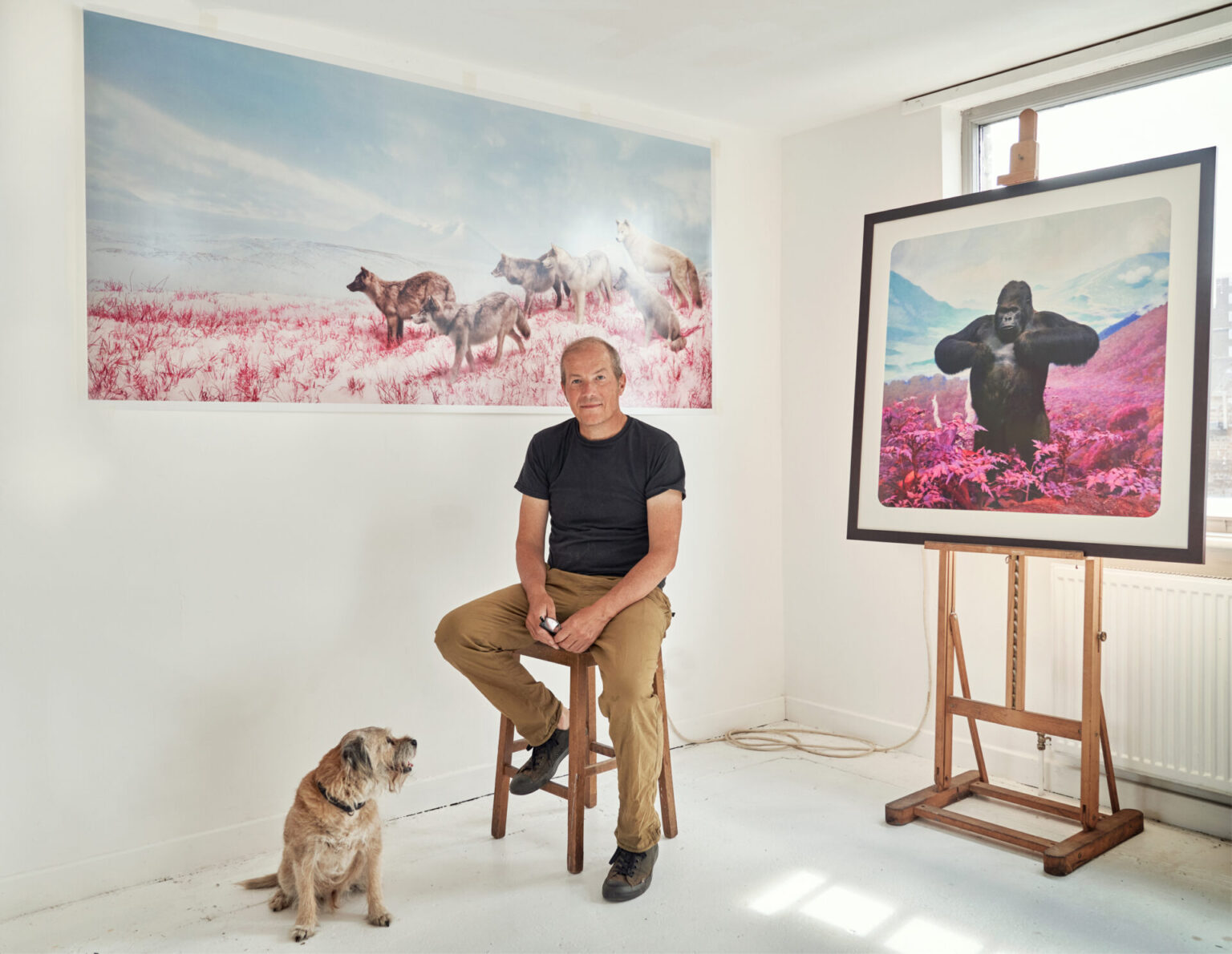
My colleagues and I are boots and all behind extremely good artists using AI. After many decades of exhibiting artists across the world, Jim Naughten – a British artist – is the first non-ANZA (Australian and New Zealand) artist, so to speak, that the gallery has ever exhibited. In doing so, we have broken our founding rule of exhibiting only Antipodean artists, drawn from a shared culture and visual history that my colleagues and I know and understand. And we have done this for a very good reason.
Naughten’s work explores our complex and fragile relationship with the natural world. Originally trained as a painter – there you go – he now works primarily with photography, digital manipulation and, more recently, photography and Artificial Intelligence.
Naughten is a bridge from the greater classicism of our previous art world to a new visual art world – drawing on a deeply creative, classically trained well of experience to champion the new frontiers of the analogue in photography, commingling with, and being extended by, the creativity of AI, instigated, directed and orchestrated by the deeply capable.
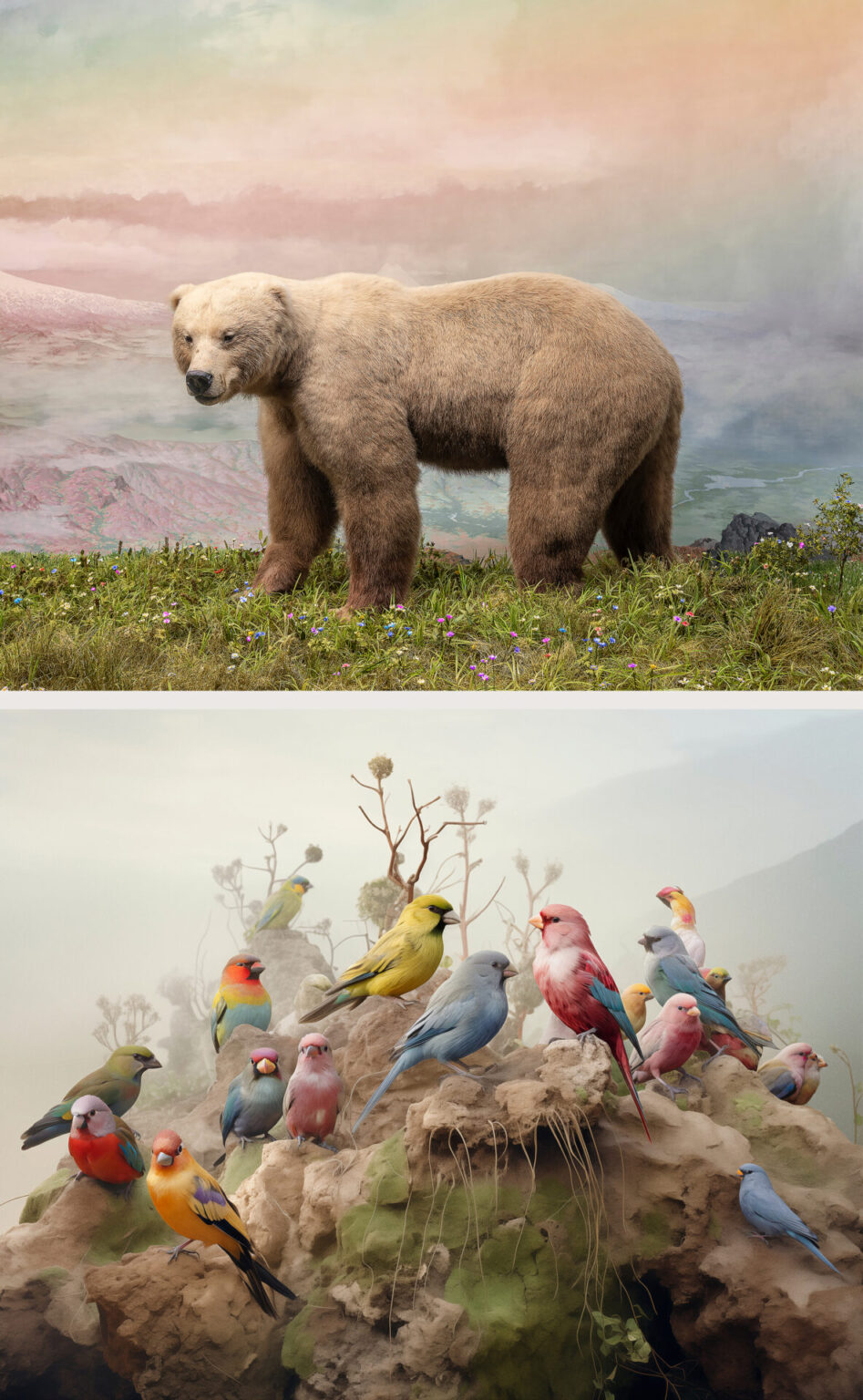
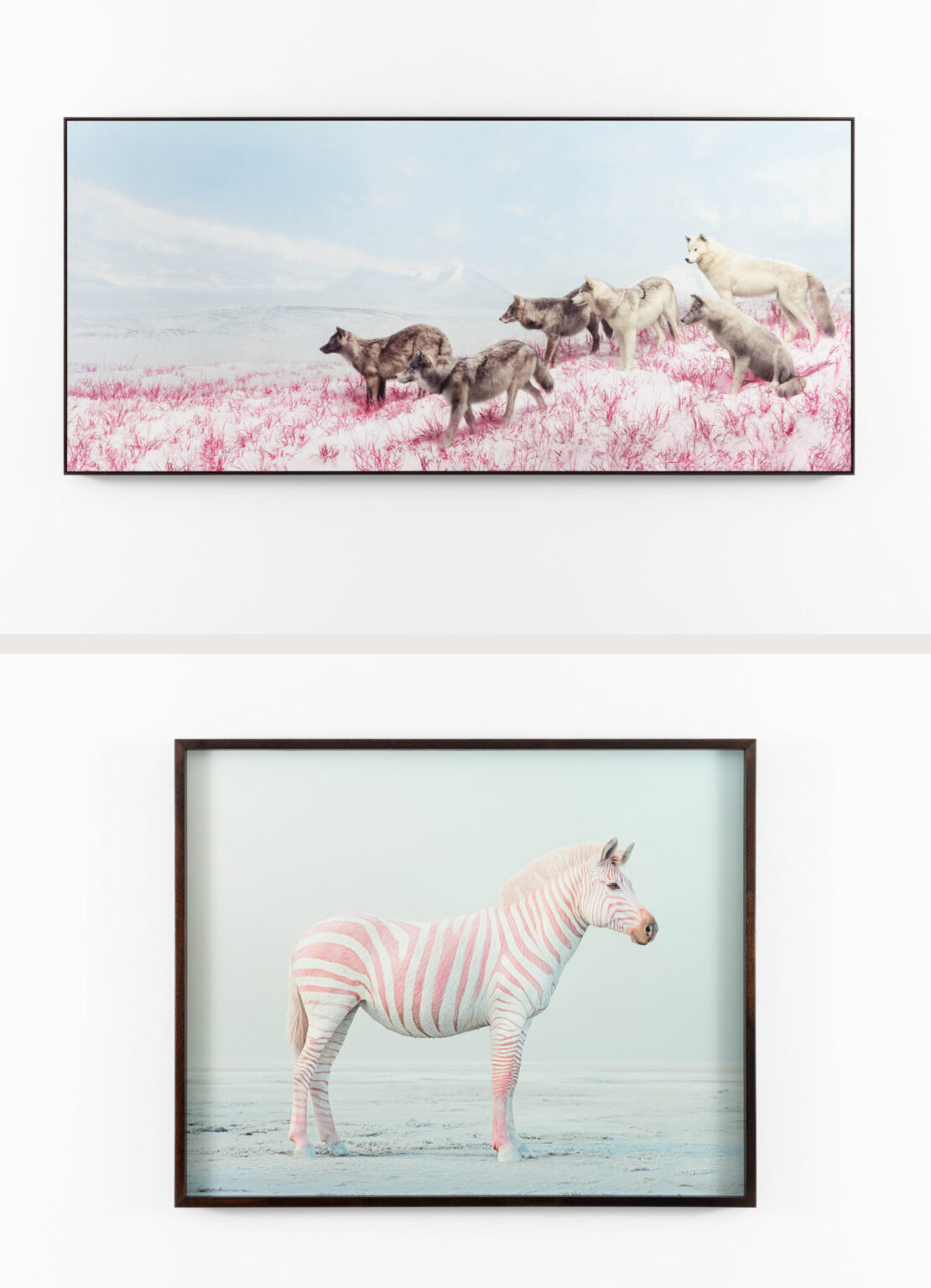
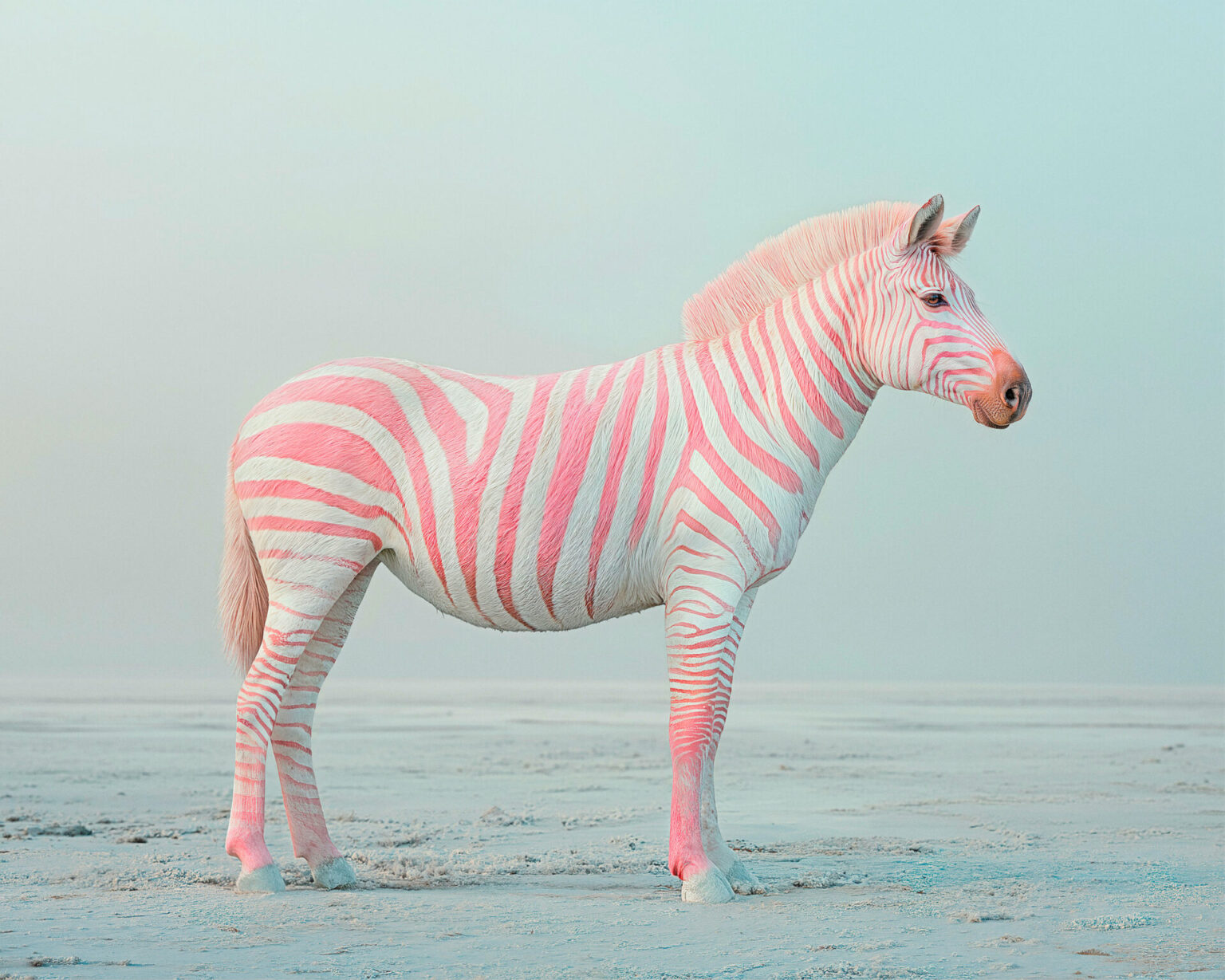
Naughten creates surreal and vivid images – a pink zebra, neon gibbons, crested birds, roving wolves – that play with memory, imagination and anxiety. He unapologetically confronts our ecological crisis, unreservedly, through the shock of the new. His recent projects, Mesozoic (2023) and Biophilia (2025), reflect a growing urgency in his practice as he highlights biodiversity loss and environmental crisis.
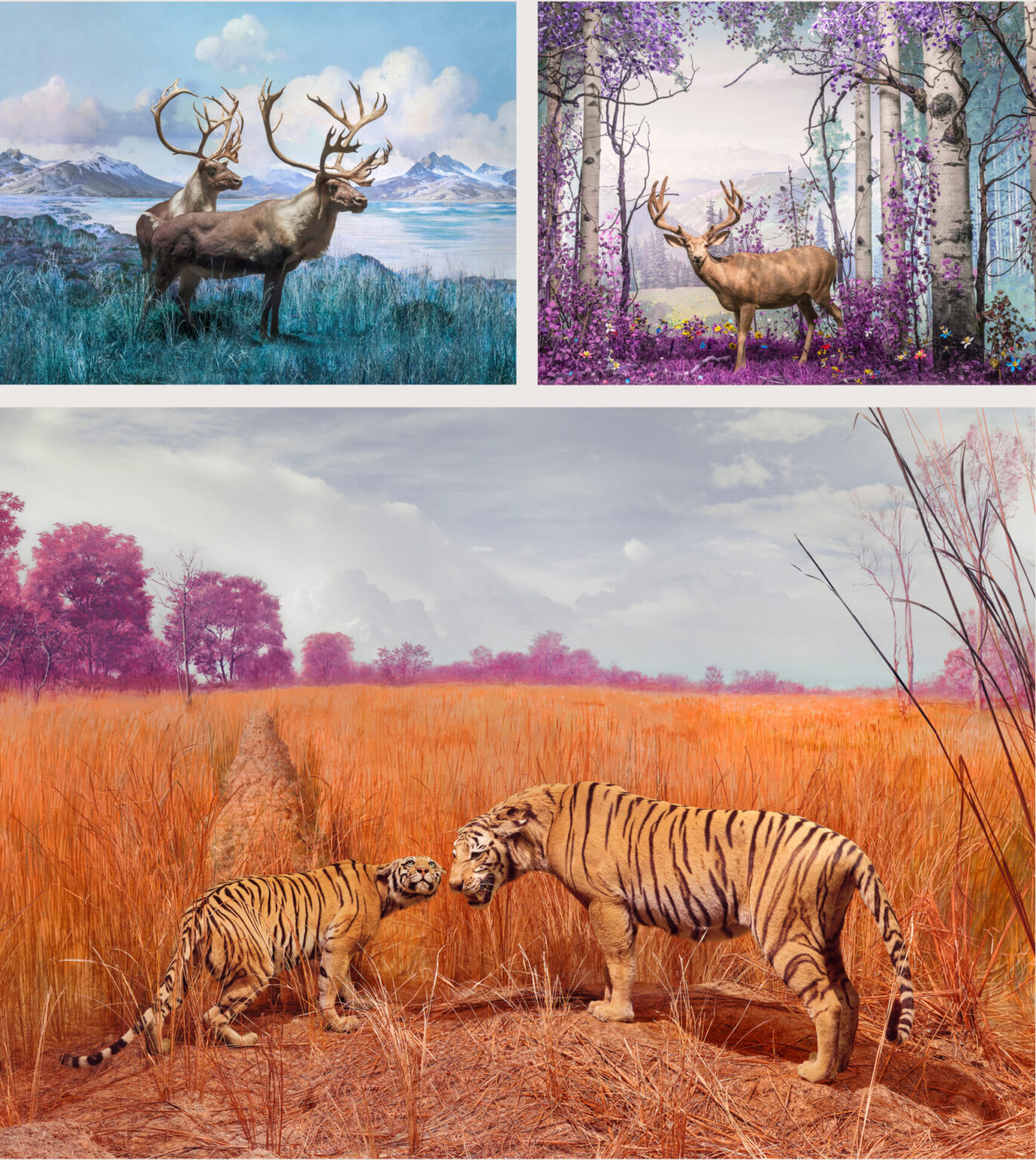
Naughten’s artworks are meticulously constructed and painterly, shaped over time through layering, editing and digital techniques. His early influences include Diane Arbus and, more recently, Richard Mosse and Patrick Waterhouse. He often collaborates with ecologists and conservationists and has raised funds for the Jane Goodall Institute.
His work has been widely exhibited internationally, including at the Wellcome Collection, the Imperial War Museum, and the Horniman Museum in London, as well as at the Royal Academy of Arts and the National Portrait Gallery. His work is held in major public and private collections, including the Wellcome Collection, the Imperial War Museum, the Horniman Museum, the Museum of Fine Arts Houston, the Honolulu Museum of Art, the Museum of Photographic Arts in San Diego, and the Boca Raton Museum of Art in Florida.
Through striking imagery and cutting-edge visual storytelling, Naughten seeks to reconnect viewers with the natural world – and to remind us of its wonder, its fragility, and our shared responsibility to protect it.
Michael Reid OAM


- XXXVIII LA Story by Michael Reid OAM April 2024
- L The Art of Jim Naughten & A Brave New World March 2026
- XLIX Paddy’s Cottage November 2025
- XLVIII Washington DC by Michael Reid OAM November 2025
- XLVII The Outdoor Fireplace at Murrurundi by Michael Reid OAM October 2025
- XLVI Amelia Zander of Zander & Co. July 2025
- XLV Marlie Draught Horse Stud by Michael Sharp June 2025
- XLIV Trump Engulfed the Fires by Michael Reid OAM February 2025
- XLIII Newcastle by Jason Mowen October 2024
- XLII The Business of Gardening by Michael Reid OAM September 2024
- XLI Carly Le Cerf by Sarah Hetherington August 2024
- XL Pecora Dairy by Michael Sharp July 2024
- XXXIX Joseph McGlennon by Michael Reid OAM May 2024
- XXXVII Julz Beresford by Michael Sharp March 2024
- XXXVI Sydney Contemporary by Jason Mowen February 2024
- XXXV The US of A by Michael Reid OAM December 2023
- XXXIV Scone Grammar School’s principal Paul Smart by Victoria Carey November 2023
- XXXIII AgQuip by Jason Mowen October 2023
- XXXII Tinagroo Stock Horse’s Jill Macintyre by Victoria Carey September 2023
- XXXI The Old Gundy School House by Victoria Carey August 2023
- XXX Annette English by Victoria Carey July 2023
- XXIX The Ghan by Jason Mowen June 2023
- XXVIII All in the family: The Arnotts May 2023
- XXVII A Capital Plan by Jason Mowen March 2023
- XXVI Mandy Archibald March 2023
- XXV Paul West February 2023
- XXIV The Other Newcastle by Jason Mowen January 2023
- XXIII Mount Woolooma Glasshouse at Belltrees December 2022
- XXII Murrurundi to Matino: with Jason Mowen November 2022
- XXI James Stokes October 2022
- XX Adelaide Bragg September 2022
- XIX Tamara Dean August 2022
- XVIII Going home: Angus Street July 2022
- XVII Belltrees Public School June 2022
- XVI A Road Trip on the New England Highway May 2022
- XV David and Jennifer Bettington: from horses to houses April 2022
- XIV Denise Faulkner: Art of the Garden March 2022
- XIII Childhood memories: Willa Arantz February 2022
- XII Riding ahead: Giddiup January 2022
- XI Ingrid Weir’s rural life December 2021
- X Life by design: William Zuccon November 2021
- IX Life on the land: The Whites October 2021
- VIII Goonoo Goonoo Station September 2021
- VII Murrurundi: a garden playground August 2021
- VI Pat’s Kitchen July 2021
- V A creative life: Charlotte Drake-Brockman June 2021
- IV Magpie Gin May 2021
- III The Cottage, Scone April 2021
- II At home with Jason Mowen March 2021
- I A town that performs February 2021
